 Blessy S
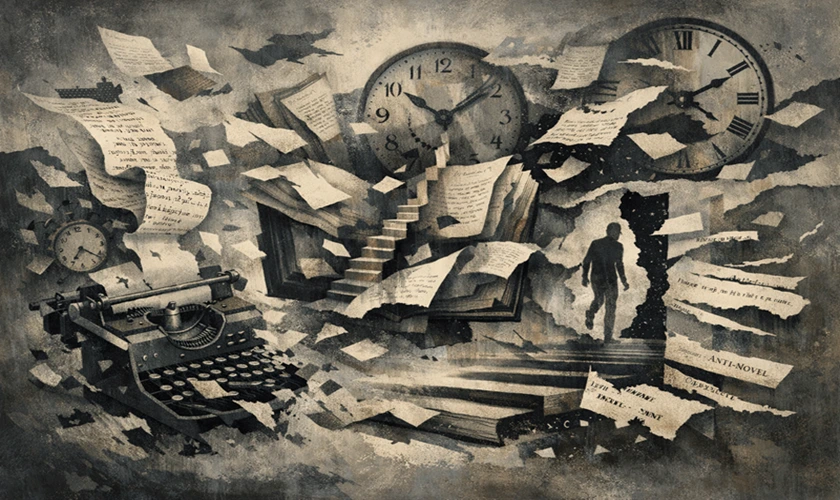
 The anti-novel, also known as experimental fiction or anti-fiction, represents a deliberate rebellion against the conventions of the traditional novel. Unlike classical narratives that rely on coherent plots, well-rounded characters, and realistic representation, the anti-novel deliberately dismantles these elements. It emerged as a literary response to the limitations of conventional storytelling, questioning long-held assumptions about meaning, form, and narrative authority.
Introduction to Anti-Novel
The rise of the anti-novel reflects a broader cultural and philosophical shift, especially in the aftermath of World War II, when faith in order, progress, and stable identity was deeply shaken. Writers no longer believed that traditional narrative forms could adequately represent the fragmented and uncertain modern world. As a result, the experimental fiction or anti-fiction sought to challenge plot, character, realism, and even the reader’s expectations.
This article examines the origins, defining features, themes, narrative techniques, major writers, critical reception, and lasting significance of the anti-novel in modern and postmodern literature.
Origin and Historical Background
The anti-novel rose to prominence in the mid-20th century, particularly in post-war Europe. The devastation caused by World War II led to a crisis of meaning, identity, and representation.
Traditional realist novels that are rooted in causality, moral coherence, and psychological depth appeared inadequate for capturing the absurdity and dislocation of modern existence.
Intellectual and Literary Influences
The anti-novel developed as a reaction against:
- Victorian realism, with its faith in social order and moral clarity
- Psychological realism, which assumed coherent inner lives
- Linear storytelling, based on cause-and-effect logic
It was shaped by several intellectual movements:
- Modernism, which had already fractured narrative form
- Existentialism, emphasizing absurdity, alienation, and meaninglessness
- Structuralism, which questioned stable meanings and narrative authority
In France, this movement became known as the Nouveau Roman (New Novel), but its influence extended across Europe and into English-language fiction.
Definition and Concept of the Anti-Novel
The term “anti-novel” does not mean the absence of a novel but rather a deliberate opposition to the traditional idea of what a novel should be. Anti-novelists reject the belief that fiction must imitate reality or offer psychological insight into characters.
Contrast of Anti-Novel with the Traditional Novel
The anti-novel stands in sharp contrast to the traditional novel, which relies on linear plots, coherent characters, and a clear narrative structure.
By deliberately rejecting these conventions, the experimental fiction or anti-fiction redefines what fiction can achieve, challenging readers to question familiar storytelling norms and engage with uncertainty, fragmentation, and experimentation.
Traditional Novel | Anti-Novel |
Structured plot | Plotlessness |
Developed characters | De-individualized figures |
Psychological depth | Emotional neutrality |
Clear meaning | Ambiguity |
Closure | Open-endedness |
The central purpose of the anti-novel is to question the nature of fiction itself: how stories are constructed, how meaning is produced, and whether narrative truth is even possible.
Recommended: Evolution of English Literature: From Firelight Tales to Digital Scrolls
Key Characteristics of Anti-Novels
Anti-novels reject the familiar rules of traditional storytelling and deliberately experiment with form, structure, and meaning. The key characteristics of anti-novels reveal how this radical literary form reshapes our understanding of fiction itself.
a) Rejection of Plot
One of the most defining features of the anti-novel is the absence of a conventional plot. There is often no clear beginning, middle, or end. Events do not follow logical progression, and conflicts, if present, are unresolved.
Rather than telling a story, anti-novels often present situations, repetitions, or observations, emphasising stasis rather than movement.
b) Fragmented Narrative Structure
Anti-novels frequently abandon linear time. Narratives may move backward, forward, or remain suspended in a repetitive present. Episodes appear disconnected, and chronology is deliberately disrupted.
Repetition and circularity replace progression, reinforcing themes of monotony, uncertainty, and existential paralysis.
c) Treatment of Character
Characters in anti-novels are often anonymous, unnamed, or reduced to functions. They lack psychological depth and personal history.
Instead of individuals with inner lives, characters become:
- Observers
- Voices
- Positions within a narrative structure
This de-individualisation reflects the modern loss of stable identity.
d) Focus on Objects and Description
Anti-novelists often devote excessive attention to objects, spaces, and surfaces, while human emotion is minimised or ignored.
Descriptions are:
- Precise
- Neutral
- Repetitive
Objects may appear more “real” than people, suggesting a world where meaning has shifted from human experience to material presence.
e) Language and Style
The language of the anti-novel is typically flat, impersonal, and restrained. Dialogue is sparse, and emotional commentary is avoided.
This antipsychological narration rejects authorial interpretation, leaving meaning unresolved and open-ended.
Major Themes in Anti-Novels
Anti-novels reflect the philosophical anxieties of the modern age. Common themes include:
- Alienation and isolation
- Absurdity of human existence
- Meaninglessness and uncertainty
- Reality versus perception
- Breakdown of identity
- Existential anxiety
Rather than offering solutions, anti-novels present these conditions as unavoidable realities.
Narrative Techniques Used in Anti-Novel
Anti-novelists experiment extensively with narrative form:
- Stream of consciousness, often fragmented or disrupted
- Subverted interior monologue, lacking psychological coherence
- Unreliable narration, where truth is unstable
- Metafiction, drawing attention to the act of writing
- Repetition and ambiguity, replacing narrative clarity
- Absence of authorial guidance, forcing reader interpretation
These techniques undermine narrative authority and challenge traditional storytelling norms.
Reader’s Role in Anti-Novels
In the anti-novel, the reader is no longer passive. Meaning is not provided; it must be constructed.
Key aspects of reader engagement include:
- Active interpretation
- Acceptance of ambiguity
- Emotional and intellectual discomfort
Reader confusion is not a flaw but a deliberate artistic strategy, reflecting the uncertainty of modern existence.
Major Writers and Works
Several writers are closely associated with the anti-novel:
- Alain Robbe-Grillet – Jealousy: obsessive objectivity and repetition
- Nathalie Sarraute – Tropisms: inner movements beneath consciousness
- Michel Butor – Passing Time: fragmented time and perspective
- Samuel Beckett – Molloy: absurdity, identity collapse, narrative breakdown
Their innovations strongly influenced postmodern writers, including those experimenting with metafiction and narrative instability.
Anti-Novel vs Traditional Novel
The contrast between the two forms highlights the radical nature of the anti-novel:
- Traditional novels emphasize plot: anti-novels resist it
- Traditional novels build character depth: anti-novels erase it
- Traditional novels seek emotional engagement: anti-novels pursue objectivity
- Traditional novels offer closure: anti-novels remain open-ended
This opposition defines the anti-novel’s identity.
Critical Reception
The anti-novel initially faced harsh criticism. Many readers and critics described it as:
- “Difficult”
- “Anti-human”
- “Unreadable”
However, others praised it for:
- Intellectual rigor
- Formal innovation
- Philosophical depth
Debates continue over its:
- Readability
- Emotional impact
- Literary value
Despite controversy, its influence is undeniable.
Influence and Legacy
The anti-novel significantly shaped postmodern fiction, contributing to:
- Metafiction
- Experimental narratives
- Non-linear storytelling
- Narrative self-reflexivity
Contemporary novels that question truth, identity, and narrative reliability owe much to the anti-novel tradition. It remains a crucial area of study in modern literary criticism.
Conclusion
The anti-novel represents one of the most radical transformations in the history of fiction. By rejecting plot, dismantling character, and embracing ambiguity, it challenges readers to rethink the very foundations of narrative art.
The anti-novel, by dismantling traditional narrative forms, expands the boundaries of fiction and compels readers to confront uncertainty, fragmentation, and the elusive nature of meaning itself.
Recommended: Realism in Literature | Origin and Characteristics