 Blessy S
 Symbols are powerful storytelling tools that allow writers to express complex ideas through simple images, objects, or recurring motifs. Understanding common symbols in literature helps readers uncover deeper layers of meaning and interpret the emotional, thematic, or psychological undertones of a text.
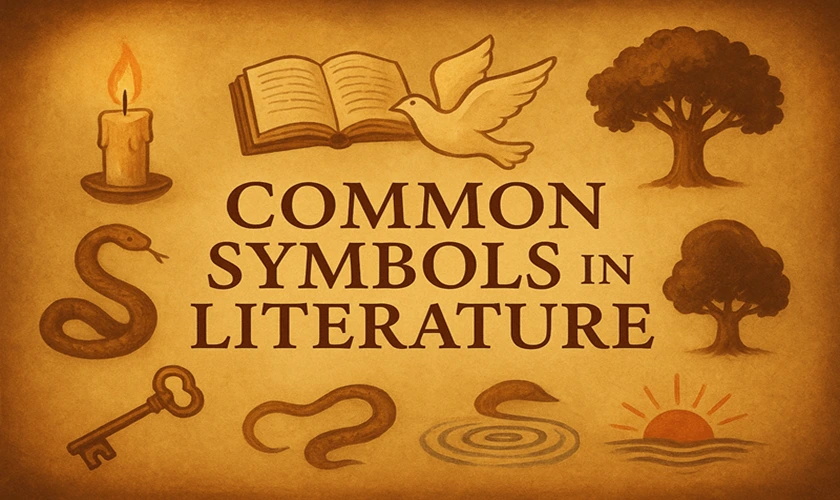
50 Common Symbols in Literature: Meanings and Examples
From ancient myths to modern novels, symbolic imagery has shaped the way stories communicate universal truths. This guide explores 50 common symbols in literature, their meanings, and why they remain timeless.
I. Natural Elements as Symbols
Natural elements are among the most common symbols in literature, allowing writers to convey emotion, theme, and atmosphere through simple but powerful natural imagery.
| S.No. | Symbol | Explanation | Example |
|---|---|---|---|
| 1 | Light | A symbol of knowledge, purity, and enlightenment | The green light across the bay in The Great Gatsby represents Gatsby’s hope and unattainable dreams. |
| 2 | Darkness | Represents ignorance, evil, fear, or the unknown | In Heart of Darkness, the darkness symbolizes moral corruption and the unknown depths of human evil. |
| 3 | Fire | Associated with destruction, passion, power, or rebirth | In Fahrenheit 451, fire represents both destructive censorship and later, knowledge and rebirth. |
| 4 | Water | Symbolizes life, cleansing, transformation, or renewal | The water imagery throughout The Adventures of Huckleberry Finn effectively symbolizes moral cleansing and spiritual rebirth as Huck and Jim navigate the Mississippi River. |
| 5 | Earth | Represents stability, grounding, or fertility | In The Grapes of Wrath, the fertile or barren earth symbolizes hope or despair for migrant families. |
| 6 | Air/Wind | Often symbolizes freedom, change, or invisible forces | The howling wind in Wuthering Heights symbolizes wild, uncontrollable emotion. |
| 7 | Rain | Can symbolize sadness, cleansing, or emotional rebirth | In The Notebook, rain symbolizes emotional release and renewed connection between the lovers. |
| 8 | Snow | Associated with purity, coldness, or isolation | In The Winter’s Tale, snow symbolizes purity and rebirth following tragedy. |
| 9 | Storms | Symbolize chaos, conflict, or emotional turmoil | The storm in King Lear mirrors Lear’s emotional turmoil and mental breakdown. |
| 10 | Sun | Represents life, strength, clarity, or optimism | In The Stranger, the oppressive sun symbolizes Meursault’s emotional numbness and existential discomfort. |
II. Animals as Symbols
Animals frequently function as powerful literary symbols, representing emotions, traits, and themes that deepen a story’s meaning beyond their literal presence.
S.No. | Symbol | Explanation | Example |
|---|---|---|---|
1 | Snake | Represents temptation, danger, evil, or transformation | The serpent in Genesis represents temptation and the fall from innocence. |
2 | Lion | Symbolizes courage, strength, and royalty | Aslan in The Chronicles of Narnia symbolizes courage, sacrifice, and divine power. |
3 | Dove | A universal symbol of peace, purity, and spiritual harmony | In Romeo and Juliet, Romeo describes Juliet as a “snowy dove trooping with crows,” highlighting her purity and beauty amidst the conflict of her family. |
4 | Raven | Often symbolizes death, mystery, or prophecy | Poe’s The Raven uses the bird to embody death, grief, and unending sorrow. |
5 | Owl | Associated with wisdom, truth, or foresight | In Harry Potter, owls symbolize wisdom and the magical world’s communication network. |
6 | Wolf | A dual symbol representing loyalty or savagery, depending on context | In Little Red Riding Hood, the wolf represents danger and predatory deception. |
7 | Butterfly | Often symbolizes transformation, beauty, or the soul | In The Metamorphosis, the idea of transformation echoes symbolism often tied to butterflies, though perverted. |
8 | Horse | Represents power, freedom, or nobility | In George Orwell’s Animal Farm, the horses Boxer and Clover represent the hardworking, yet ultimately exploited, working class. |
9 | Dragon | Symbolizes danger, chaos, wealth, or cosmic power depending on culture | In Beowulf, the dragon represents greed and the destructive nature of hoarded power. |
10 | Eagle | Represents vision, freedom, and rising above adversity | In Native American literature, the eagle symbolizes spiritual vision and freedom. |
III. Objects as Symbols
Objects in stories often serve as powerful literary symbols, carrying deeper meanings that reveal themes, emotions, and character motivations beyond their literal function.
S.No. | Symbol | Explanation | Example |
|---|---|---|---|
1 | Key | Represents access, knowledge, or unlocking potential | In Coraline, the key symbolizes access to forbidden knowledge and danger. |
2 | Mirror | Symbolizes truth, self-reflection, or inner conflict | In Snow White, the mirror symbolizes vanity and the pursuit of truth. |
3 | Book | Associated with learning, mystery, or forbidden knowledge | In Fahrenheit 451, books symbolize freedom of thought and resistance to oppression. |
4 | Candle | Represents hope, guidance, or the passage of time | In Gothic novels, candles symbolize guidance and the fragile nature of hope. |
5 | Clock | Symbolizes mortality and the relentless progression of time | The ticking clock in The Tell-Tale Heart symbolizes guilt and the passage of time. |
6 | Mask | Represents hidden identity, deception, or social roles | In The Phantom of the Opera, the mask symbolizes hidden identity and shame. |
7 | Ring | Symbolizes eternity, commitment, or power | The One Ring in The Lord of the Rings symbolizes power, corruption, and temptation. |
8 | Sword | Represents justice, courage, or conflict | Excalibur in Arthurian legend symbolizes rightful kingship and divine justice. |
9 | Crown | Associated with royalty, authority, or responsibility | In Macbeth, the crown symbolizes ambition, power, and guilt. |
10 | Door | Symbolizes opportunity, transition, or secrecy | In The Yellow Wallpaper, doors symbolize restriction and the lack of freedom for women. |
IV. Colors as Symbols
In exploring common symbols in literature, colors stand out as some of the most powerful, conveying emotion, theme, and character insight through simple visual cues.
S.No. | Symbol | Explanation | Example |
|---|---|---|---|
1 | Red | Represents passion, danger, love, or violence | In The Scarlet Letter, the red “A” symbolizes sin, passion, and later, resilience. |
2 | Blue | Symbolizes calm, sadness, or depth | In The Great Gatsby, blue often symbolizes melancholy and illusion. |
3 | Black | Often associated with death, evil, or the unknown | In Gothic literature, black symbolizes death, evil, and the unknown. |
4 | White | Represents purity, innocence, or emptiness | The white whale in Moby-Dick symbolizes the unknowable and the sublime terror of nature. |
5 | Green | Symbolizes nature, growth, envy, or renewal | The Shire in The Lord of the Rings uses green to symbolize peace, nature, and renewal. |
6 | Gold | Associated with wealth, divinity, or glory | Gold in Treasure Island symbolizes wealth and the greed it inspires. |
7 | Purple | Symbolizes royalty, mystery, or spirituality | In The Color Purple, purple symbolizes dignity, spirituality, and personal awakening. |
8 | Yellow | Represents happiness, caution, or sickness depending on tone | In Dostoevsky’s Crime and Punishment, the yellow wallpaper in Raskolnikov’s apartment symbolizes poverty, decay, and a stifling environment. |
9 | Grey | Symbolizes ambiguity, neutrality, or lifelessness | The grey valley of ashes in The Great Gatsby symbolizes decay, poverty, and moral emptiness. |
10 | Orange | Represents creativity, energy, or warning | In dystopian fiction, orange often symbolizes artificiality or controlled energy (e.g., uniforms in The Giver). |
V. Settings and Places as Symbols
Settings and places in literature often function as powerful literary symbols, shaping themes and emotions by turning locations into deeper representations of a character’s inner world or a story’s central ideas.
S.No. | Symbol | Explanation | Example |
|---|---|---|---|
1 | Forest | Represents mystery, danger, subconscious fears, or self-discovery | In Into the Woods, the forest symbolizes the unknown, personal trials, and transformation. |
2 | Garden | Symbolizes paradise, innocence, or creation | The garden in The Secret Garden symbolizes healing, rebirth, and restored innocence. |
3 | Desert | Represents isolation, hardship, spiritual emptiness, or purification | In The Alchemist, the desert symbolizes spiritual challenges and inner purification. |
4 | River | Symbolizes life’s journey, change, or the passage of time | Huck and Jim’s journey on the Mississippi River symbolizes freedom and moral growth. |
5 | Mountain | Represents obstacles, enlightenment, or spiritual ascent | In Lord of the Rings, mountains often symbolize obstacles or sacred destinations. |
6 | City | Symbolizes human society, complexity, ambition, or corruption | Gotham City in Batman symbolizes urban corruption and moral decay. |
7 | Road | Represents life’s path, choices, or personal growth | In The Road by Cormac McCarthy, the road symbolizes survival and the journey of life. |
8 | Island | Symbolizes isolation, survival, or the human psyche | In Lord of the Flies, the island symbolizes isolation and the revelation of humanity’s true nature. |
9 | House | Represents identity, family, or memory—each room symbolizing different aspects of self | The house in House of Leaves symbolizes psychological complexity and hidden trauma. |
10 | Graveyard | Associated with death, the past, or unresolved trauma | The graveyard in Great Expectations symbolizes Pip’s fear, his origins, and the weight of the past. |
Why Do These Common Symbols in Literature Matter?
The reason these common symbols in literature appear across time periods and cultures is simple: they reflect shared human experiences. Authors use symbols to add emotional depth, create thematic resonance, and allow readers to draw their own interpretations. Learning to identify symbolism not only strengthens literary analysis but also enhances enjoyment of stories at every level.
Whether you’re a student, writer, or casual reader, recognizing these common literary symbols opens the door to understanding the layers of meaning that make literature rich, timeless, and universal.
Recommended: What is the Symbolism of Peter Pan’s Green Attire?